
Home / Journal / Ingredients Explained
Ingredients ExplainedWhen Is a Supplement Really Vegan? Capsules, Vitamin D and Ingredient Labels Explained
Capsule shells, vitamin D sources and vegan labels explained, plus a practical checklist for reading the full supplement label.

QUICK ANSWER
A supplement is vegan when no ingredients of animal origin have been intentionally used in the finished product. In UK food law, however, the term 'vegan' is not given one statutory definition, so the safest practical check is the product's dietary statement together with the full ingredients list.[1][2] Look at the capsule shell, the source of vitamin D and any other ingredients that may be animal-derived. A vegan label is also separate from allergen labelling and does not mean a product is free from every allergen.[1]
The word 'vegan' on a supplement can feel like a complete answer. Often it is a useful starting point, but it does not explain how the capsule was made, where a vitamin came from or whether the product was made in a facility that also handles allergens.
Those are different questions. Vegan suitability is about ingredients of animal origin. Allergen information is about the presence or possible accidental presence of regulated allergens. Reading the label becomes much easier once those two checks are kept separate.[1]
What does a vegan label actually tell you?
Current UK guidance explains that a vegan label means no ingredients of animal origin were intentionally used in making the product. It also notes that 'vegan' is not defined in food law in the same way as a regulated free-from claim. General food law still prohibits false or misleading information.[1][2]
That means a clear vegan statement is useful, but it should sit alongside a full ingredients list. For food supplements sold in Great Britain, the label must provide required information including the recommended daily amount, ingredients and relevant warnings.[3]
Start with the capsule shell
Hard capsules can use different shell materials. Gelatin is animal-derived. Non-gelatin alternatives include hydroxypropyl methylcellulose, usually shortened to HPMC or described as hypromellose, and pullulan. These materials behave differently in manufacturing and storage, which is why capsule-shell research often compares gelatin, HPMC and pullulan directly.[4]
A plant-based shell does not automatically make the whole supplement vegan. The powder or oil inside the capsule, processing aids and other ingredients still need checking. The useful question is therefore not only 'What is the shell made from?' but 'Is the finished product stated to be suitable for vegans?'
A USEFUL LABEL CLUE
On a SupplementMe Probiotic 10 Billion CFU label, the capsule shell is listed as hydroxypropyl methylcellulose and gellan gum, and the finished product is stated to be suitable for vegetarians and vegans. The dietary statement confirms the finished product; the shell wording explains one part of how that is achieved.
Vitamin D needs a source check
Vitamin D2 and vitamin D3 describe two forms of vitamin D, not whether the ingredient is vegan. Vitamin D2 is commonly produced from fungi or UV-treated yeast. Vitamin D3 used in supplements is often obtained from lanolin, which comes from sheep's wool, but vegan vitamin D3 can also be obtained from lichen.[5]
So 'vitamin D3' on its own is not enough to decide. If vegan suitability matters, look for a vegan statement or ask the manufacturer to confirm the ingredient source. Do not assume every D3 product is animal-derived, and do not assume a product is vegan simply because its capsule shell is plant-based.
Tablets and gummies still need checking
Tablets avoid the question of a capsule shell, but they can still contain coatings, glazing agents, flavours or other ingredients that need checking. Gummies also vary in formulation. The product format is not a reliable shortcut for dietary suitability.
The full ingredients list and dietary statement matter more than whether the product looks like a tablet, capsule or gummy. If the wording is unclear, the manufacturer should be able to explain the source of the relevant ingredient.
Vegan does not mean allergen-free
This distinction is important. UK guidance says vegan labelling does not guarantee that a food is free from a particular allergen. A vegan product may still carry precautionary wording such as 'may contain' if there is a genuine risk of accidental cross-contact.[1]
Someone avoiding milk because they are vegan is making a dietary choice. Someone with a milk allergy needs safety information about whether milk protein may be present. The same word cannot safely answer both questions.
A five-step vegan supplement check
- Look for a clear statement that the finished product is suitable for vegans.
- Read the full ingredients list rather than relying on the front label.
- For capsules, check whether the shell is gelatin, HPMC, pullulan or another material.
- For vitamin D3, check the source or ask the manufacturer to confirm it.
- Read allergen and precautionary statements separately from the vegan claim.
| Label detail | What it can tell you |
|---|---|
| Suitable for vegans | The clearest finished-product dietary statement. |
| Gelatin capsule | Animal-derived shell, so the product is not vegan. |
| HPMC / hypromellose shell | Non-gelatin shell; the rest of the formulation still needs checking. |
| Vitamin D3 | The vitamin form, not its source. Check for lanolin or lichen information. |
| May contain allergen wording | A separate cross-contact warning, not proof that an animal-derived ingredient was intentionally used. |
WHAT TO REMEMBER
- A vegan statement and the full ingredients list should be read together.
- A plant-based capsule shell does not confirm every ingredient inside is vegan.
- Vitamin D3 may be derived from lanolin or from a vegan source such as lichen.
- Tablets and gummies still need a full ingredient check.
- Vegan labelling and allergen safety labelling answer different questions.
From our range
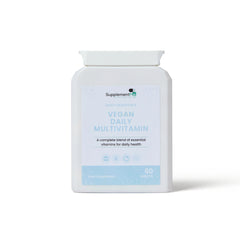
Vegan Daily Multivitamin
Our current multivitamin label states that the finished product is suitable for vegetarians and vegans. Use the product page and physical label for the current formulation, serving instructions, warnings and allergen information.
Evidence note
This guide is educational and is not a substitute for personalised medical advice. The references below explain the scientific, regulatory and public-health concepts discussed in the article. They are not evidence that a particular SupplementMe product will produce a specific health outcome. If you are pregnant, breastfeeding, taking medicines, managing a medical condition or unsure whether a supplement is suitable for you, speak to a qualified healthcare professional.
Sources & Further Reading
We prioritise peer-reviewed research, systematic reviews and authoritative UK guidance. Sources were checked when this article was prepared on 19 September 2026.
Food Standards Agency. Best practice guidance on food allergen labelling. Explains that a vegan label means no ingredients of animal origin were intentionally used, that the term is not defined in food law and that vegan labelling is separate from allergen safety labelling. [Official UK guidance]
View source →Department of Health. Food Supplements: Labelling Summary. Explains the legal framework for supplement labelling and the prohibition on misleading information. [Official UK guidance]
View source →UK Government. Food supplements: guidance on labelling and composition requirements. [Official UK guidance]
View source →Yang J, et al. Moisture sorption and desorption properties of gelatin, HPMC and pullulan hard capsules. International Journal of Biological Macromolecules. 2020;159:659-666. [Peer-reviewed comparative study] DOI: 10.1016/j.ijbiomac.2020.05.110
View source →Scientific Advisory Committee on Nutrition. Fortifying foods and drinks with vitamin D: main report. Includes discussion of vitamin D2 and D3 sources used in foods and supplements. [UK scientific advisory report]
View source →Keep reading

Multivitamin or Individual Supplements: What's the Difference?
Multivitamins and individual supplements compared in plain English, with a practical checklist for avoiding duplicated nutrients.

What Is Acerola? Vitamin C from Fruit Explained
Acerola fruit, extracts and vitamin C amounts explained, including the label details that matter when comparing supplements.

Can You Take Different Supplements Together? How to Check for Overlapping Ingredients
A practical guide to combining supplements, adding up repeated nutrients and knowing when to ask a pharmacist for...