
Multivitamin or Individual Supplements: What's the Difference?
Multivitamins and individual supplements compared in plain English, with a practical checklist for avoiding duplicated nutrients.

QUICK ANSWER
A multivitamin combines several vitamins and usually minerals in one product. An individual supplement focuses on one nutrient or a smaller group. Neither approach is automatically better. A multivitamin can make a broad routine simpler, while an individual product can provide a more specific nutrient and amount. The important checks are the recommended serving, the amount of each nutrient, what you already get from food or other supplements and whether specific professional guidance applies.[1][2]
The choice between a multivitamin and separate supplements sounds like a choice between broad and precise. That is partly true, but the labels matter more than the category name.
There is no single standard formula that every multivitamin follows. Products can contain different nutrients, different amounts and different serving sizes.[1] Individual supplements vary too. Some provide a modest amount of one nutrient, while others provide much more than a multivitamin would.
What does a multivitamin do differently?
A multivitamin puts several nutrients into one daily routine. That can be convenient for someone who wants broad coverage without opening several bottles. It also makes it easier to see many nutrient reference values together on one panel.
Convenience does not mean completeness. Some multivitamins provide small amounts of nutrients that are difficult to fit into a tablet, while others include amounts above the labelling reference value. The word 'multivitamin' does not tell you the exact formulation.[1]
What does an individual supplement do differently?
An individual supplement focuses on a particular nutrient, such as vitamin D, vitamin C or iron. That can be useful when public-health guidance, a diagnosed deficiency or advice from a healthcare professional points to a specific nutrient.
The trade-off is complexity. Several separate products mean several labels, serving sizes and opportunities for overlap. A targeted approach only stays targeted if the total routine is checked.
THE LABEL DECIDES
A multivitamin can contain 20 or more nutrients, but the amount of any one nutrient may be lower than in a single-nutrient product. Compare the amount per recommended daily serving, not the product category or the number printed most prominently on the front.
Convenience versus control
| Multivitamin | Individual supplement |
|---|---|
| Several nutrients in one routine. | One nutrient or a smaller group. |
| Convenient when broad coverage is the aim. | More control over the chosen nutrient and amount. |
| Can make overlap harder to notice if another product is added. | Can create a more complicated routine when several are combined. |
| Formulas vary widely between brands. | Strengths and formulations also vary widely. |
| May not provide a large amount of every nutrient. | May provide much more of one nutrient than a multivitamin. |
Check serving size before comparing
A fair comparison starts with the recommended daily serving. One multivitamin may be one tablet a day; another may require two tablets. A single-nutrient product may list its amount per capsule even when the directions suggest more than one capsule.
Put both products on the same basis: the amount supplied by the full recommended daily serving. Then compare the nutrients, amounts and percentage NRV where one is established.[3]
Watch for overlapping nutrients
Overlap is the main practical risk when a multivitamin and individual products are combined. The NIH Office of Dietary Supplements notes that excessive nutrient intakes are more likely among people who take a multivitamin as well as separate vitamin or mineral supplements.[1]
Start with nutrients that appear in both products. Add the amounts from the stated daily servings, and remember that fortified foods can contribute too. NRV is a labelling reference, not a personalised target or an upper safety limit.
When might a targeted product make more sense?
Sometimes guidance is nutrient-specific. NHS advice, for example, recommends folic acid before pregnancy and during early pregnancy, and UK vitamin D guidance gives specific seasonal advice.[2][5] A healthcare professional may also recommend a particular nutrient or dose after considering diet, medicines, symptoms or test results.
That does not mean everyone needs separate products. It means a targeted reason should lead to a targeted label check rather than assuming that more bottles are automatically more precise.
When might a multivitamin be the simpler option?
A multivitamin may suit someone who values a single, repeatable routine and wants several nutrients together. It can also make sense when the aim is general coverage rather than a specific clinical dose.
It still should not be treated as a substitute for a varied diet. Foods provide fibre and many other components that a tablet does not.[1][2]
A practical decision checklist
- Write down why you are considering a supplement.
- Check whether current UK guidance names a specific nutrient or life stage.
- Compare amounts using the full recommended daily serving.
- List every nutrient repeated across your products.
- If you take medicines or have been advised to use a particular dose, check with a pharmacist or other qualified healthcare professional.
WHAT TO REMEMBER
- There is no standard multivitamin formula; labels can differ substantially.
- A multivitamin is convenient, but it may not provide the amount of every nutrient you expect.
- An individual supplement offers more control over one nutrient, but several products can make a routine harder to check.
- Compare complete daily servings and add up repeated nutrients.
- Neither format replaces a varied, balanced diet or personalised professional advice.
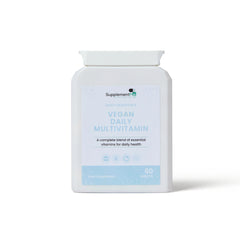
From our range
Vegan Daily Multivitamin
Our current multivitamin combines a range of vitamins and minerals in a two-tablet daily serving. Use the current product page and physical label to check the formulation, amounts, NRV percentages, directions and warnings before combining it with another supplement.
Evidence note
This guide is educational and is not a substitute for personalised medical advice. The references below explain the scientific, regulatory and public-health concepts discussed in the article. They are not evidence that a particular SupplementMe product will produce a specific health outcome. If you are pregnant, breastfeeding, taking medicines, managing a medical condition or unsure whether a supplement is suitable for you, speak to a qualified healthcare professional.
Sources & Further Reading
We prioritise peer-reviewed research, systematic reviews and authoritative UK guidance. Sources were checked when this article was prepared on 19 September 2026.
NIH Office of Dietary Supplements. Multivitamin/mineral Supplements: Fact Sheet for Health Professionals. Explains the wide variation in formulas and the potential for overlapping intakes. [Authoritative evidence summary]
View source →NHS. Vitamins and minerals. Summarises the role of a varied diet and current UK public-health information on key nutrients. [Official UK health guidance]
View source →UK Government. Food supplements: guidance on labelling and composition requirements. [Official UK guidance]
View source →NIH Office of Dietary Supplements. Multivitamin/mineral Supplements: Fact Sheet for Consumers. Includes practical advice on checking labels and avoiding excessive combined intakes. [Authoritative consumer guidance]
View source →NHS. Folic acid. Includes current guidance for people who are pregnant or trying for a baby. [Official UK health guidance]
View source →Keep reading

When Is a Supplement Really Vegan? Capsules, Vitamin D and Ingredient Labels Explained
Capsule shells, vitamin D sources and vegan labels explained, plus a practical checklist for reading the full supplement...

What Is Acerola? Vitamin C from Fruit Explained
Acerola fruit, extracts and vitamin C amounts explained, including the label details that matter when comparing supplements.

Can You Take Different Supplements Together? How to Check for Overlapping Ingredients
A practical guide to combining supplements, adding up repeated nutrients and knowing when to ask a pharmacist for...