
Home / Journal / Ingredients Explained
Ingredients ExplainedWhat Is Acerola? Vitamin C from Fruit Explained
Acerola fruit, extracts and vitamin C amounts explained, including the label details that matter when comparing supplements.

QUICK ANSWER
Acerola, or Malpighia emarginata, is a tropical fruit also called Barbados cherry or West Indian cherry. It naturally contains high amounts of vitamin C, but the amount varies with the variety, ripeness and processing.[1][2] Supplements commonly use an acerola powder, concentrate or extract. When comparing labels, separate the weight of the acerola ingredient from the amount of vitamin C it is declared to provide.[3]
Acerola is often described as acerola cherry, but it is not the same fruit as the sweet or sour cherries commonly sold in UK shops. Its accepted scientific name is Malpighia emarginata, and it grows in warm tropical and subtropical regions.[1]
The fruit became useful to the food and supplement industries because of its naturally high ascorbic acid content. Ascorbic acid is vitamin C. That simple connection explains most of the ingredient's appeal, but it does not mean every acerola powder or extract contains the same amount.
Why is acerola associated with vitamin C?
Peer-reviewed reviews describe acerola as one of the richest natural fruit sources of ascorbic acid.[1] Vitamin C is an essential water-soluble vitamin involved in functions including collagen production, antioxidant activity and normal immune function.[4]
The fruit also contains other plant compounds, but a supplement label should not use the general reputation of the fruit as a substitute for stating the actual vitamin C amount.
The amount in the fruit is not fixed
Acerola's vitamin C content varies. Variety, growing conditions and stage of ripeness all matter. Research following acerola fruit development found that total vitamin C declined as the fruit ripened, even while other characteristics changed.[2]
That variability is normal for a plant ingredient. It is also one reason manufacturers use controlled powders, concentrates and extracts rather than treating every piece of fruit as chemically identical.
How does acerola become a supplement ingredient?
The fruit can be processed into juice, concentrated material, powder or extract. Drying and extraction make the ingredient easier to measure, transport and formulate into capsules or tablets.
Quality-control research on acerola-based supplements has focused on confirming the botanical material and measuring ascorbic acid accurately. A 2022 study developed a spectroscopy method specifically to evaluate acerola supplement quality and quantify vitamin C.[3]
TWO NUMBERS, TWO DIFFERENT JOBS
A label may give the weight of the acerola extract and then state how much vitamin C that extract provides. The first number describes the fruit-derived ingredient. The second number is the declared nutrient amount used for a meaningful vitamin C comparison.
How to read an acerola supplement label
Start with the recommended daily serving. Then find both the acerola ingredient amount and the vitamin C amount. They are not interchangeable.
| Label line | What it means |
|---|---|
| Acerola extract: 500 mg | The weight of the acerola-derived ingredient in the stated serving. |
| Providing vitamin C: 125 mg | The amount of vitamin C declared as being supplied by that ingredient. |
| 156% NRV | The amount compared with the nutrient reference value used for labelling. |
| One capsule typically provides | The basis for the listed amounts; always compare it with the directions for use. |
Those example figures match the current SupplementMe Acerola Vitamin C Complex label for one capsule. They show why '500 mg acerola' does not mean '500 mg vitamin C'. The vitamin C amount is 125 mg.
Does fruit-derived vitamin C automatically work better?
A fruit source can be an important product preference, but the source description alone does not prove that one finished supplement produces better health outcomes than another. The useful evidence would need to compare the actual formulations, doses and outcomes, not just the words 'from fruit'.
A careful label comparison therefore starts with vitamin C per daily serving, then considers the source, other ingredients, capsule material, directions and warnings.
What does 'natural vitamin C' mean on a label?
The word 'natural' can describe where an ingredient came from, but it is not a complete quality measure. It does not tell you how concentrated the ingredient is, how much vitamin C remains after processing or whether the finished product has been compared with another formulation.
Specific numbers and a transparent ingredient list are more useful than broad source wording. If a label gives only a large acerola number without stating the vitamin C amount, it is harder to compare with another product.
A quick acerola label check
- Find the recommended daily serving.
- Identify whether the ingredient is a powder, concentrate or extract.
- Separate the acerola ingredient weight from the vitamin C amount provided.
- Use the vitamin C amount and %NRV for like-for-like nutrient comparison.
- Check the complete ingredients list, directions, warnings and storage instructions.
WHAT TO REMEMBER
- Acerola is Malpighia emarginata, also called Barbados cherry or West Indian cherry.
- Its natural vitamin C content varies with the fruit and its stage of ripeness.
- Supplements can use acerola powders, concentrates or extracts.
- The weight of acerola extract is not the same as the amount of vitamin C it provides.
- Source wording alone does not prove that one finished formulation works better than another.
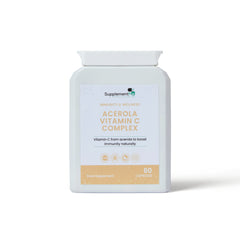
From our range
Acerola Vitamin C Complex
Our current label lists 500 mg of acerola cherry extract per capsule, providing 125 mg of vitamin C. It also includes parsley, blackcurrant, elderberry and rosehip ingredients. Follow the current product label for serving instructions, warnings and storage.
Evidence note
This guide is educational and is not a substitute for personalised medical advice. The references below explain the scientific, regulatory and public-health concepts discussed in the article. They are not evidence that a particular SupplementMe product will produce a specific health outcome. If you are pregnant, breastfeeding, taking medicines, managing a medical condition or unsure whether a supplement is suitable for you, speak to a qualified healthcare professional.
Sources & Further Reading
We prioritise peer-reviewed research, systematic reviews and authoritative UK guidance. Sources were checked when this article was prepared on 19 September 2026.
Prakash A, Baskaran R. Acerola, an untapped functional superfruit: a review on latest frontiers. Journal of Food Science and Technology. 2018;55:3373-3384. [Peer-reviewed scientific review] DOI: 10.1007/s13197-018-3309-5
View source →Oliveira LS, et al. Antioxidant metabolism during fruit development of different acerola clones. Journal of Agricultural and Food Chemistry. 2012;60(32):7957-7964. [Peer-reviewed experimental study] DOI: 10.1021/jf3005614
View source →Bourafai-Aziez A, et al. Development, Validation, and Use of 1H-NMR Spectroscopy for Evaluating the Quality of Acerola-Based Food Supplements and Quantifying Ascorbic Acid. Molecules. 2022;27(17):5614. [Peer-reviewed analytical study] DOI: 10.3390/molecules27175614
View source →NIH Office of Dietary Supplements. Vitamin C: Fact Sheet for Health Professionals. [Authoritative evidence summary]
View source →UK Government. Food supplements: guidance on labelling and composition requirements. [Official UK guidance]
View source →Keep reading

When Is a Supplement Really Vegan? Capsules, Vitamin D and Ingredient Labels Explained
Capsule shells, vitamin D sources and vegan labels explained, plus a practical checklist for reading the full supplement...

Multivitamin or Individual Supplements: What's the Difference?
Multivitamins and individual supplements compared in plain English, with a practical checklist for avoiding duplicated nutrients.

Can You Take Different Supplements Together? How to Check for Overlapping Ingredients
A practical guide to combining supplements, adding up repeated nutrients and knowing when to ask a pharmacist for...