
Can You Take Different Supplements Together? How to Check for Overlapping Ingredients
A practical guide to combining supplements, adding up repeated nutrients and knowing when to ask a pharmacist for advice.

QUICK ANSWER
Different supplements can sometimes be used in the same routine, but the answer depends on the ingredients, the amounts in the full daily servings and any medicines or health conditions involved. Start by listing every product, then add up nutrients that appear more than once. NRV percentages help with label comparison but are not upper safety limits. If you take medicines, are pregnant or breastfeeding, are due to have surgery or have a medical condition, ask a pharmacist or other qualified healthcare professional before combining products.[1][2][3]
A multivitamin, a vitamin D product and an immunity blend can look like three different ideas. On the back labels, all three may contain vitamin D. That is how a routine becomes more complicated than the number of bottles suggests.
The aim is not to assume that every overlap is dangerous or that every combination is fine. It is to turn the routine into one list that can be checked.
Start with a complete product list
Write down every supplement you take regularly or occasionally. Include powders, gummies, drinks and fortified products, not only tablets and capsules. Add the recommended serving you actually use.
The NIH Office of Dietary Supplements recommends keeping a complete record of supplements and medicines and sharing it with healthcare professionals.[2] That is particularly useful because brand names do not reveal every active ingredient.
Compare full daily servings
Amounts on the front of a pack may refer to one capsule, two gummies or the whole daily serving. Convert each product to the amount supplied by the recommended daily serving before adding anything together.[1]
If directions allow a range, such as one to three capsules a day, record the amount you actually intend to take and do not exceed the stated recommended dose.
THE SIMPLEST METHOD
Make one row for each repeated nutrient. Add a column for every product and a final column for the total daily amount. This does not decide whether the total is right for you, but it makes the overlap visible and gives a pharmacist something concrete to review.
Use NRV as a reference, not a ceiling
NRV stands for Nutrient Reference Value. On a UK supplement label, it provides a standard reference point for vitamins and minerals. It helps compare two products, but it is not a personalised prescription and it is not the same as a tolerable upper intake level.
A total above 100% NRV is not automatically unsafe, and a total below 100% is not automatically appropriate. Different nutrients have different evidence, upper limits and circumstances. Some ingredients, including many botanicals, have no NRV at all.
Build a one-page overlap check
| Check | What to record | Why it matters |
|---|---|---|
| Daily serving | Number of tablets, capsules or gummies | Makes each product comparable. |
| Repeated nutrient | Name and form where shown | Reveals overlap across products. |
| Amount | mg, mcg or IU per daily serving | Lets you add like units together. |
| %NRV | Percentage shown on the label | Useful reference, but not a safety ceiling. |
| Medicines and conditions | A complete list for your pharmacist | Helps identify interactions or reasons for tailored advice. |
Remember fortified foods and drinks
Some breakfast cereals, plant-based drinks and other foods contain added vitamins and minerals. These are easy to miss because they are not in the supplement cupboard. If you are trying to understand total intake, include regularly consumed fortified foods too.
Check medicine interactions separately
Ingredient overlap is only one part of the question. Supplements can also interact with prescription or over-the-counter medicines. The NIH gives examples including St John's wort and medicines, while NHS services advise discussing supplements with a doctor or pharmacist when medicines or health conditions are involved.[2][5]
A label cannot account for your full medication history. Do not start, stop or change a prescribed medicine because of general information about supplements.
When should you ask a pharmacist?
Ask before combining products if you take prescribed medicines, are pregnant or breastfeeding, have a diagnosed condition, are preparing for surgery, have been advised to take a specific clinical dose or are unsure how to interpret the totals.
Bring the packaging or a clear photo of each label. The exact ingredient, amount and serving are more useful than the product name alone.
A six-step routine check
- List every supplement, fortified product and medicine you use.
- Convert each supplement to its complete daily serving.
- Highlight every ingredient that appears more than once.
- Put repeated amounts into the same unit before adding them.
- Keep NRV separate from upper-limit or clinical guidance.
- Ask a pharmacist or qualified healthcare professional when medicines, pregnancy, health conditions or clinical doses are involved.
WHAT TO REMEMBER
- Different product names can hide repeated nutrients.
- Always compare full recommended daily servings.
- NRV is a labelling reference value, not an upper safety limit.
- Fortified foods and drinks can add to total intake.
- A pharmacist should review combinations involving medicines or individual medical circumstances.
From our range
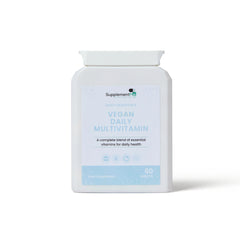
Vegan Daily Multivitamin
A multivitamin is a useful starting point for an overlap check because it contains several named nutrients and NRV percentages. If you add another supplement, compare both complete daily servings and follow the current labels. This article does not determine whether a particular combination is suitable for you.
Evidence note
This guide is educational and is not a substitute for personalised medical advice. The references below explain the scientific, regulatory and public-health concepts discussed in the article. They are not evidence that a particular SupplementMe product will produce a specific health outcome. If you are pregnant, breastfeeding, taking medicines, managing a medical condition or unsure whether a supplement is suitable for you, speak to a qualified healthcare professional.
Sources & Further Reading
We prioritise peer-reviewed research, systematic reviews and authoritative UK guidance. Sources were checked when this article was prepared on 19 September 2026.
UK Government. Food supplements: guidance on labelling and composition requirements, including recommended daily portions and required warnings. [Official UK guidance]
View source →NIH Office of Dietary Supplements. Frequently Asked Questions: interactions between dietary supplements and medications, and keeping a supplement and medicine record. [Authoritative consumer guidance]
View source →NIH Office of Dietary Supplements. Dietary Supplements: What You Need to Know. Covers serving information, active ingredients and interaction risks. [Authoritative consumer guidance]
View source →NHS. Vitamin D. Includes current UK guidance and the adult daily upper limit for vitamin D. [Official UK health guidance]
View source →Guy's and St Thomas' NHS Foundation Trust. Herbal remedies and dietary supplements. Includes practical advice on supplements, medicines and speaking to healthcare professionals. [Official NHS guidance]
View source →Keep reading

When Is a Supplement Really Vegan? Capsules, Vitamin D and Ingredient Labels Explained
Capsule shells, vitamin D sources and vegan labels explained, plus a practical checklist for reading the full supplement...

Multivitamin or Individual Supplements: What's the Difference?
Multivitamins and individual supplements compared in plain English, with a practical checklist for avoiding duplicated nutrients.

What Is Acerola? Vitamin C from Fruit Explained
Acerola fruit, extracts and vitamin C amounts explained, including the label details that matter when comparing supplements.