
Home / Journal / Ingredients Explained
Ingredients ExplainedWhat Does a 30:1 Herbal Extract Actually Mean?
Extract ratios explained without the marketing shorthand: what 30:1 describes, why it is not a potency score and which details make extracts comparable.

Quick answer
A 30:1 plant-to-extract ratio generally indicates that about 30 parts by mass of starting botanical material were used to produce 1 part of extract. It is a manufacturing relationship, not proof that the finished product is ‘30 times stronger’ or ‘30 times more effective’. The solvent, plant part, raw material, extraction process, standardisation and any carriers also matter.[1][2]
Herbal supplement labels love ratios. You might see 5:1 on one bottle, 10:1 on another and 30:1 on a third. It is natural to read those numbers like a volume dial: 30 must be three times stronger than 10.
That is not what the ratio proves. Plant-to-extract ratios are useful manufacturing information, but botanical extracts are chemically more complicated than the ratio alone can describe.[1]
Start with the basic idea
A plant-to-extract ratio describes the relationship between the mass of botanical starting material and the mass of extract produced. In European herbal terminology you may also see the phrase drug-extract ratio, or DER. Here, ‘drug’ refers to the herbal substance, not to a pharmaceutical drug in the everyday sense.[2]
In a simplified example, if 30 kg of dried starting herb were processed to produce 1 kg of native extract, that would correspond to a 30:1 relationship.
The important word is “relationship”
A 30:1 ratio helps describe how much starting botanical material relates to the amount of extract obtained. It does not, on its own, measure the biological effect of the extract in a person.
Why 30:1 does not mean “30 times stronger”
The problem with the phrase ‘30 times stronger’ is that it turns a manufacturing ratio into an efficacy claim. The ratio does not tell you that 1 mg of extract will produce 30 times the biological effect of 1 mg of raw plant material.
A major peer-reviewed review on plant-to-extract ratios makes this point directly: ratios can provide useful information about the relationship to the starting material, but they do not completely describe a botanical extract. Raw-material quality, extraction solvent, process conditions, excipients and chemical characterisation can all influence the final material.[1]
So two extracts could both carry a 30:1 ratio and still not be chemically identical.
The extraction solvent can change what comes out of the plant
Plants contain many different compounds, and those compounds do not all dissolve equally well in every solvent. Water, ethanol and other extraction systems can therefore pull out different chemical profiles.
Experimental studies repeatedly show that changing the extraction solvent can change extract yield and measured phytochemical composition. Salminen, for example, found that extraction and sample-processing choices changed the measured yield of individual tannins from birch leaves.[3] Other botanical studies have similarly found significant differences in compounds recovered with different solvents.[4]
That is why a scientifically useful extract description often includes the extraction solvent as well as the ratio.
Plant species and plant part matter too
‘Ashwagandha extract’ or ‘green tea extract’ still leaves questions. Which species? Root, leaf, fruit or another part? How was the starting material prepared?
Different plant parts can contain different mixtures and concentrations of constituents. Reproducible botanical research therefore depends on properly identifying the plant material and describing how the extract was made. Best-practice guidance for botanical research places strong emphasis on this chemical and botanical characterisation.[5]
What does “native” or “genuine” extract mean?
This is where extract labels can get more technical. European Medicines Agency guidance uses the concept of a genuine, sometimes called native, extract. In simple terms, that refers to the extract material itself before certain excipients or carriers used to make a practical finished ingredient are counted.[2]
A commercial powdered extract may need carriers or other excipients for manufacturing or stability. That means the mass of the finished extract ingredient can be different from the mass of the native extract portion.
You do not need to become a herbal pharmacognosy specialist to shop for a supplement. The useful lesson is simply that apparently simple statements such as ‘600 mg of 30:1 extract’ need the manufacturer's actual specification and label context before you start converting them into a supposed amount of raw herb.
Be careful with “equivalent to X mg of raw herb” maths
You will sometimes see a ratio multiplied by the extract weight to create a raw-herb-equivalent figure. Mathematically, that may reflect the declared relationship between starting material and native extract. Scientifically, it still does not make the extract identical to swallowing that mass of the unextracted herb.
Extraction is selective. Some constituents are concentrated, some may be poorly extracted, and processing can alter the composition. The extract ratio is useful context, not a guarantee of chemical or biological equivalence.[1][5]
What about standardised extracts?
Some botanical extracts are standardised or quantified to contain a defined amount or range of a particular marker or group of compounds. That gives another piece of information beyond the extraction ratio.
Standardisation can make it easier to describe and reproduce an extract, but it still does not mean a single marker explains every property of the plant. Botanical extracts are mixtures, and good characterisation looks at more than one headline number.[1][5]
What should you check on a herbal extract label?
- The botanical name where available.
- The part of the plant used, such as root or leaf.
- The amount of extract per daily serving.
- The extract ratio or DER if it is provided.
- The extraction solvent or method where the manufacturer declares it.
- Any standardisation or marker compound information.
- The recommended daily serving, warnings and complete ingredient list.
What the ratio tells you, and what it does not
| A 30:1 ratio can tell you | A 30:1 ratio cannot prove |
|---|---|
| The stated mass relationship between starting botanical material and extract. | That the product is 30 times more effective than raw herb. |
| That the extract is relatively concentrated in relation to its starting material. | That two 30:1 extracts have the same chemical profile. |
| Useful manufacturing context when combined with other specifications. | That a larger ratio automatically makes a better product. |
| A basis for understanding the declared botanical input. | That evidence from a different extract automatically applies to this one. |
The ratio is worth reading. Just read it as one part of the specification, not as a score out of 30.
When researchers evaluate botanical extracts properly, they try to describe enough about the plant and extraction process for someone else to understand what was actually tested. That is a much better model for consumers too: look for clear identity, amount, ratio and formulation rather than chasing the largest ratio on the label.
What to remember
- 30:1 describes a plant-to-extract relationship, not a 30-fold promise of effect.
- Extraction solvent and process can change the chemical composition of an extract.
- Plant species and plant part are important parts of extract identity.
- Native extract, carriers and standardisation can change how a finished ingredient should be interpreted.
- A ratio is useful only when read alongside the rest of the extract specification.
From our range
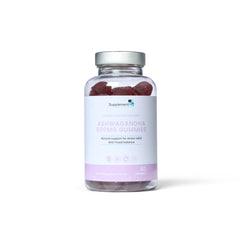
Ashwagandha 600mg Gummies
Our Ashwagandha gummies use a 30:1 root extract. This guide explains what that ratio means in general. Use the current product page and physical label for the exact serving and formulation details rather than calculating a health effect from the ratio alone.
Evidence note
This guide is educational and is not a substitute for personalised medical advice. The references below explain the scientific and regulatory concepts discussed in the article. They are not evidence that a particular SupplementMe product will produce a specific health outcome. If you are pregnant, breastfeeding, taking medicines, managing a medical condition or unsure whether a supplement is suitable for you, speak to a qualified healthcare professional.
Sources & Further Reading
We prioritise peer-reviewed research, systematic reviews and authoritative UK guidance. Sources were checked when this article was prepared on 16 August 2026.
Monagas M, Brendler T, Brinckmann J, et al. Understanding plant to extract ratios in botanical extracts. Frontiers in Pharmacology. 2022;13:981978. DOI: 10.3389/fphar.2022.981978
Peer-reviewed scientific review →European Medicines Agency, Committee on Herbal Medicinal Products. Guideline on declaration of herbal substances and herbal preparations in herbal medicinal products / traditional herbal medicinal products.
Authoritative technical guidance →Salminen JP. Effects of Sample Drying and Storage, and Choice of Extraction Solvent and Analysis Method on the Yield of Birch Leaf Hydrolyzable Tannins. Journal of Chemical Ecology. 2003;29:1289-1305. DOI: 10.1023/A:1024249016741
Peer-reviewed experimental study →Lezoul NEH, Belkadi M, Habibi F, Guillén F. Extraction Processes with Several Solvents on Total Bioactive Compounds in Different Organs of Three Medicinal Plants. Molecules. 2020;25(20):4672. DOI: 10.3390/molecules25204672
Peer-reviewed extraction study →Heinrich M, Jalil B, Abdel-Tawab M, Echeverria J, Kulic Z, McGaw LJ, et al. Best Practice in the chemical characterisation of extracts used in pharmacological and toxicological research - The ConPhyMP Guidelines. Frontiers in Pharmacology. 2022;13:953205. DOI: 10.3389/fphar.2022.953205
Peer-reviewed best-practice guidance →Benayad O, Bouhrim M, Tiji S, Kharchoufa L, Addi M, Drouet S, et al. Phytochemical Profile, alpha-Glucosidase, and alpha-Amylase Inhibition Potential and Toxicity Evaluation of Extracts from Citrus aurantium (L) Peel, a Valuable By-Product from Northeastern Morocco. Biomolecules. 2021;11(11):1555. DOI: 10.3390/biom11111555
Peer-reviewed botanical extraction study →Keep reading

When Is a Supplement Really Vegan? Capsules, Vitamin D and Ingredient Labels Explained
Capsule shells, vitamin D sources and vegan labels explained, plus a practical checklist for reading the full supplement...

Multivitamin or Individual Supplements: What's the Difference?
Multivitamins and individual supplements compared in plain English, with a practical checklist for avoiding duplicated nutrients.

What Is Acerola? Vitamin C from Fruit Explained
Acerola fruit, extracts and vitamin C amounts explained, including the label details that matter when comparing supplements.