
What Are "GLP-1 Supplements"? What the Trend Actually Means
GLP-1 supplements explained: what GLP-1 is, why medicines are different and what UK guidance says about supplement claims.

QUICK ANSWER
GLP-1 is a hormone your gut releases after eating. Prescription GLP-1 receptor agonists are medicines designed to act on the GLP-1 receptor and are prescription-only in the UK.[1] The phrase "GLP-1 supplement" does not make a food supplement equivalent to those medicines. Some nutrients and fibres can influence natural GLP-1 secretion in research, but a 2026 review found the human evidence was mostly small, short-term and heterogeneous.[2][3] UK advertising rules also restrict supplement claims that imply prescription-like GLP-1 effects.[4][5]
GLP-1 used to sound like the kind of acronym you would only meet in an endocrinology textbook. Now it appears in social videos, news stories and supplement marketing, often beside words such as fullness, appetite, metabolism and weight management.
That creates an easy misunderstanding. Three different ideas are being blurred together: the GLP-1 hormone your body makes naturally, prescription medicines that act on the GLP-1 receptor, and food supplements marketed around the GLP-1 trend. They are related by language, but they are not interchangeable.
What is GLP-1 in the first place?
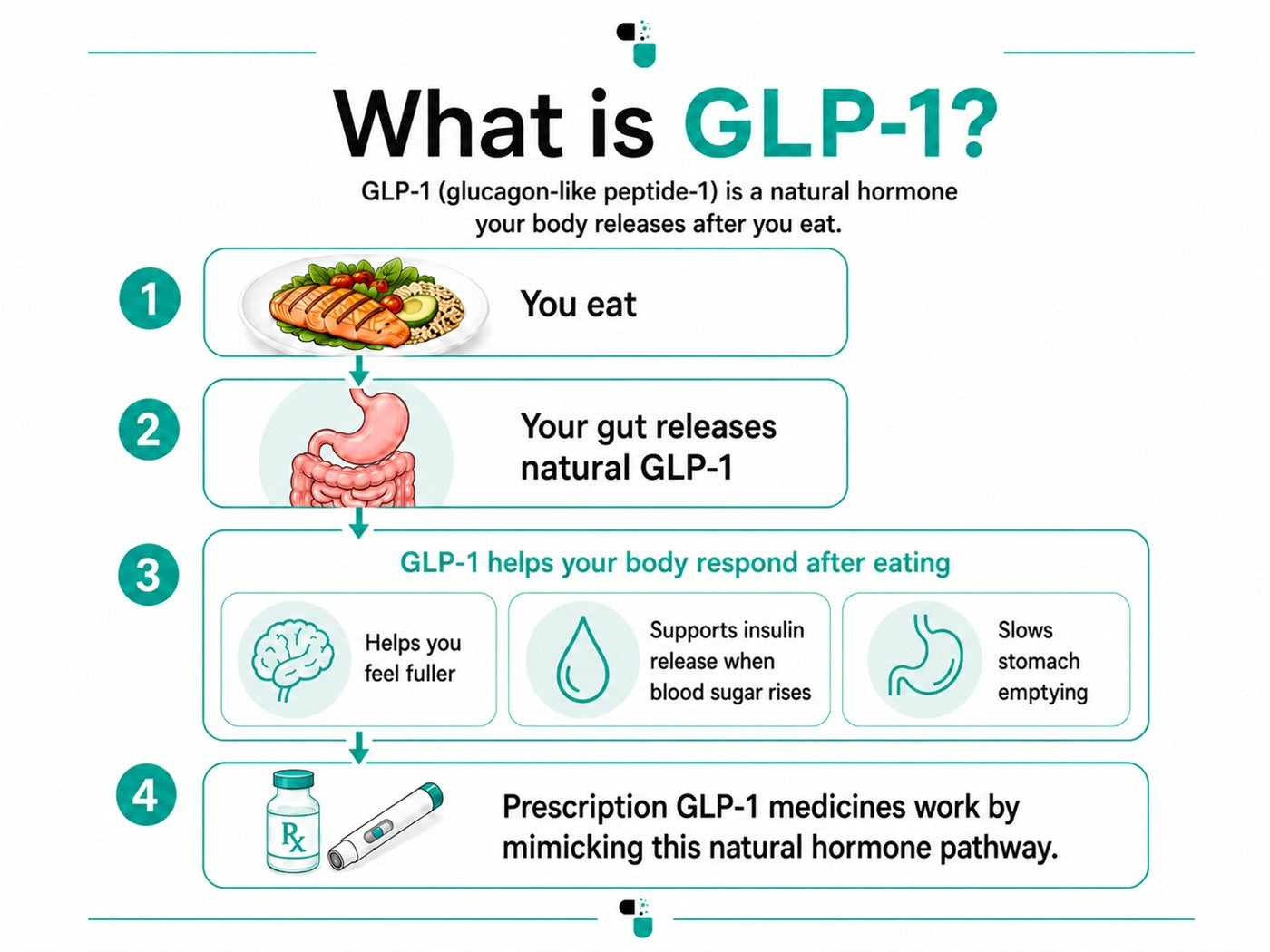
GLP-1 stands for glucagon-like peptide-1. It is an incretin hormone released after nutrient intake. Among its normal physiological actions, GLP-1 helps increase insulin release when appropriate, suppresses glucagon, slows gastric emptying and contributes to satiety.[2]
Natural GLP-1 is also short-lived in the circulation. That matters because a temporary rise in a hormone after a meal is not automatically equivalent to maintaining pharmacological stimulation of the same receptor with a medicine designed to last much longer.[2]
What do prescription GLP-1 medicines do?
GLP-1 receptor agonists are medicines that mimic aspects of the natural hormone by activating the GLP-1 receptor. In the UK, medicines in this area include semaglutide and liraglutide; tirzepatide acts on both GLP-1 and GIP receptors. Their licensed uses differ, and the MHRA says GLP-1 medicines are prescription-only and should be used under healthcare-professional supervision.[1]
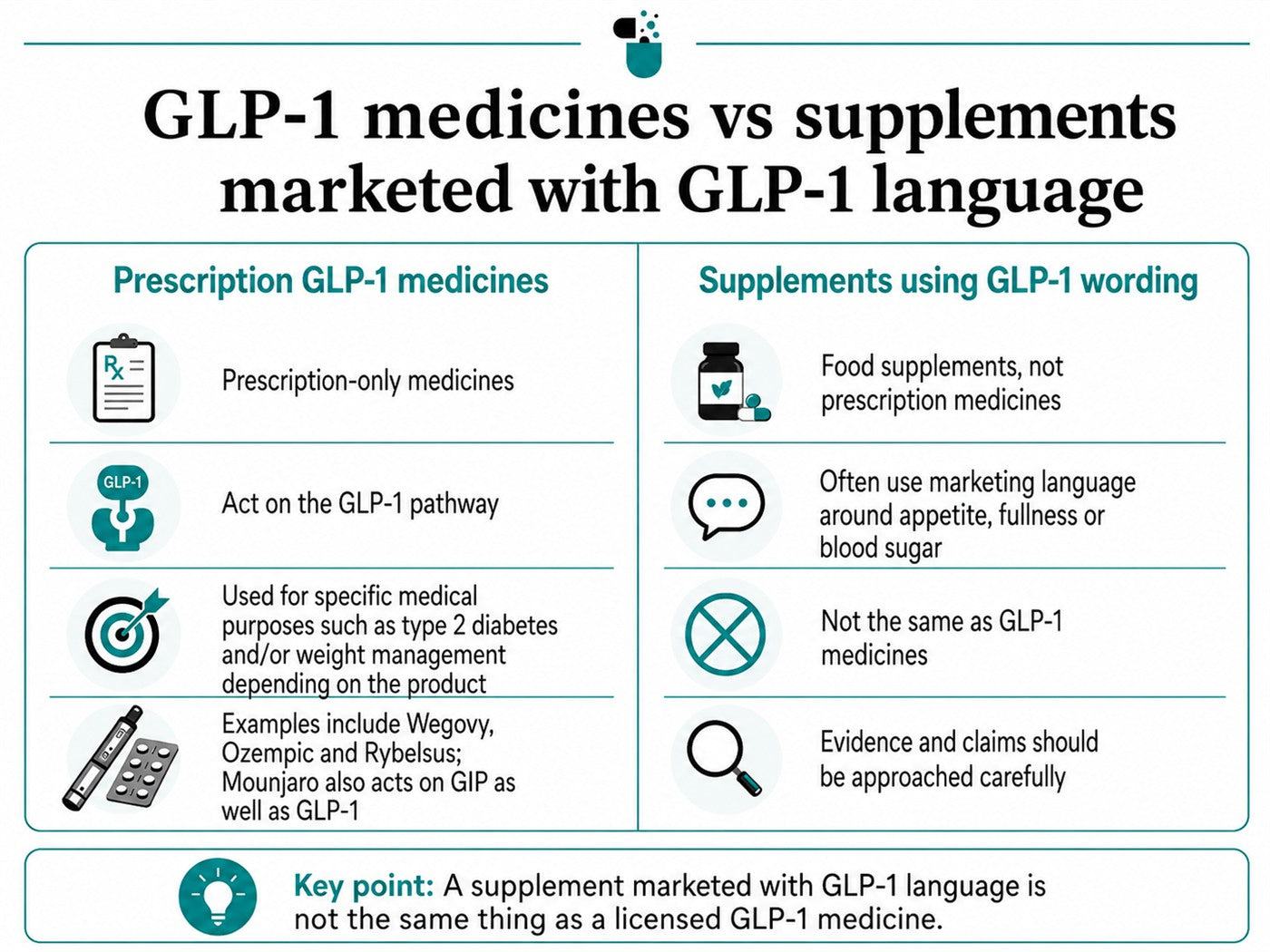
That regulatory status is a major difference. A licensed medicine has been assessed for safety, quality and effectiveness for particular uses. A food supplement sits in a different regulatory category and should not be assumed to produce the same effect simply because its marketing uses the letters GLP-1.
GLP-1 DOES NOT JUST MEAN AN INJECTION
The phrase "weight-loss injections" is common, but it is already incomplete. In June 2026, the MHRA approved the first GLP-1 receptor agonist tablet for weight loss and weight management in the UK.[6] GLP-1 describes the biological pathway being targeted, not a particular delivery format.
So what is a "GLP-1 supplement"?
Unlike vitamin D, magnesium or iron, GLP-1 is not the nutrient inside an ordinary food supplement. In current marketing, the phrase "GLP-1 supplement" may be attached to products containing fibres or other ingredients positioned around fullness, appetite, gut hormones or natural GLP-1 release.
The wording by itself does not tell you a standard ingredient, dose, mechanism or proven outcome. The useful question is therefore not "Is this a GLP-1 supplement?" but "What is actually in it, how much is supplied, and what evidence supports the specific claim being made?"
Can food or supplement ingredients influence natural GLP-1?
Yes - at a physiological level, nutrient intake is one of the normal triggers for GLP-1 release.[2] Researchers have therefore studied carbohydrates, fats, proteins, fibres and other dietary factors. A 2026 scoping review identified 52 human studies of defined dietary fibres and GLP-1 or satiety, but most were acute, the median study contained only 19 participants, and results varied substantially between fibre types. The authors described some promising signals while concluding that longer-term, real-world research is still needed.[3]
Why is that not the same as taking a GLP-1 medicine?
A change in a naturally produced hormone after eating an ingredient is not the same intervention as a medicine engineered to activate a receptor at a defined dose and with a much longer pharmacological action.[1][2] A study can also show a change in circulating GLP-1 without proving a meaningful effect on body weight, appetite or long-term health.
What are UK regulators saying about supplement claims?
UK advertising rules make the distinction especially important for brands. CAP guidance says food and supplement health claims must be authorised, and it specifically warns against ads that state or imply a supplement has effects associated with prescription GLP-1 medicines.[4]
In May 2026, the ASA upheld complaints about a food supplement marketed with claims about increasing GLP-1, reducing cravings and acting as a natural alternative to weight-loss products. The ruling found that the advertising made unauthorised health and medicinal claims, including comparisons that implied prescription-like effects.[5]
| Term | What it is | What to remember |
|---|---|---|
| Natural GLP-1 | Hormone released after eating. | Short-lived normal physiology. |
| GLP-1 receptor agonist medicine | Prescription medicine that activates GLP-1; some also target GIP. | Licensed and assessed as a medicine. |
| "GLP-1 supplement" | Food supplement marketed with GLP-1 language. | Not an OTC GLP-1 medicine. |
What claims should make you sceptical?
Be cautious when a food supplement is presented as a "natural" version of a prescription medicine, described as producing the same effect as injections, or sold with guaranteed claims about hunger, cravings or weight loss. Those comparisons can make a supplement sound more drug-like than the evidence or regulatory status supports.[4][5]
Also look past phrases such as "GLP-1 support" and read the ingredient panel. A mechanism-sounding phrase can feel scientific without telling you whether the finished product has been tested, whether the dose matches the research or whether the claimed outcome was actually measured in people.
How should you read a "GLP-1 supplement" label?
- Start with the ingredient list and amount per serving, not the GLP-1 headline.
- Separate evidence that an ingredient changes a hormone marker from evidence for an actual health outcome.
- Check whether the research used the same ingredient, dose and formulation.
- Treat comparisons with prescription medicines as a warning sign, not proof of effectiveness.
- If you use prescription diabetes or weight-management medication, ask your prescriber or pharmacist before adding a supplement.
A label can still be useful even when the marketing is trendy. The goal is simply to bring the claim back down to something testable: what is in the product, how much is there, and what has actually been shown?
The practical takeaway
The science of GLP-1 is real. The loose supplement category built around the term is something different. Foods and nutrients can influence natural gut-hormone signalling, but that does not turn a supplement into a GLP-1 receptor agonist or make it an alternative to prescription treatment.
WHAT TO REMEMBER
- GLP-1 is a natural hormone; prescription GLP-1 receptor agonists are medicines, not food supplements.
- "GLP-1 supplement" does not mean a product works like a prescription GLP-1 medicine.
- Some nutrients and fibres can influence endogenous GLP-1, but current human evidence is often short-term and mixed.
- UK rules restrict unauthorised GLP-1 claims and prescription-like comparisons, so judge the ingredients, dose and evidence instead.
A NOTE FROM SUPPLEMENTME - WHY WE ARE COVERING THIS TOPIC
SupplementMe does not sell products described as "GLP-1 supplements" or as alternatives to prescription weight-management medicines. We cover the topic because GLP-1 language is increasingly appearing in supplement marketing; our range remains focused on straightforward everyday supplements.
Evidence note
This guide is educational, not personalised medical advice. Do not start, stop or change a prescribed GLP-1 medicine because of this article. If you use diabetes or weight-management medication, speak to your prescriber or pharmacist before adding supplements.
Sources & Further Reading
We prioritise peer-reviewed research and authoritative UK regulatory guidance. Sources were checked when this article was prepared on 25 August 2026.
Medicines and Healthcare products Regulatory Agency. GLP-1 medicines for weight loss and diabetes: what you need to know. Updated 5 February 2026. [Official UK regulatory guidance]
View source →Andersen A, Lund A, Knop FK, Vilsbøll T. Glucagon-like peptide 1 in health and disease. Nature Reviews Endocrinology. 2018;14(7):390-403. [Peer-reviewed scientific review] DOI: 10.1038/s41574-018-0016-2
View source →View DOI →de Jong JCBC, Lentjes MGW, Pietersma KF, Pasman WJ, Wopereis S, Hoevenaars FPM. Dietary fibers to boost endogenous GLP-1 secretion and satiety: a scoping review. Frontiers in Endocrinology. 2026;17:1880500. [Peer-reviewed scoping review] DOI: 10.3389/fendo.2026.1880500
View source →View DOI →Advertising Standards Authority / Committee of Advertising Practice. Weight control: Food and Food Supplements. 2026. Includes current UK guidance on GLP-1 comparisons and health claims for food supplements. [Official UK advertising guidance]
View source →Advertising Standards Authority. ASA Ruling on GLP-1 Pro Ltd t/a GuLP-1. 6 May 2026. [Official UK advertising ruling]
View source →Medicines and Healthcare products Regulatory Agency. First GLP-1 tablet for weight loss approved in the UK. 11 June 2026. [Official UK regulatory announcement]
View source →Keep reading

When Is a Supplement Really Vegan? Capsules, Vitamin D and Ingredient Labels Explained
Capsule shells, vitamin D sources and vegan labels explained, plus a practical checklist for reading the full supplement...

Multivitamin or Individual Supplements: What's the Difference?
Multivitamins and individual supplements compared in plain English, with a practical checklist for avoiding duplicated nutrients.

What Is Acerola? Vitamin C from Fruit Explained
Acerola fruit, extracts and vitamin C amounts explained, including the label details that matter when comparing supplements.