
Home / Journal / Ingredients Explained
Ingredients ExplainedVitamin D2 vs Vitamin D3: What's the Difference?
D2 and D3 explained in plain English: where they come from, how they compare in research and what to check on a vitamin D label.

QUICK ANSWER
Vitamin D2 and vitamin D3 can both raise vitamin D status, but they are different forms. D2 is ergocalciferol and is commonly derived from fungi or UV-treated yeast. D3 is cholecalciferol and is usually derived from lanolin, although vegan D3 can also come from lichen. Systematic reviews generally find that D3 raises total blood 25-hydroxyvitamin D more effectively than D2.[1][2][3]
Vitamin D has one of those labels that looks simple until you compare two bottles. One says D2. Another says D3. Then you find people online saying D3 is better, while another product proudly uses D2. It is easy to turn a small difference in chemistry into a much bigger argument than the evidence supports.
The useful version is simpler. D2 and D3 are both genuine forms of vitamin D. They follow much of the same pathway in the body, but they are not identical, and the difference can matter when researchers measure how much total 25-hydroxyvitamin D, or 25(OH)D, rises in the blood.
What do D2 and D3 actually mean?
Vitamin D2 is called ergocalciferol. Vitamin D3 is called cholecalciferol. After absorption, both forms can be converted into vitamin D metabolites in the body, and blood 25(OH)D is commonly used as the main marker of vitamin D status.[1][2]
The names therefore describe the form of vitamin D, not a separate vitamin with a completely different job. If a label says 'vitamin D', the ingredient panel or specification may tell you whether that vitamin D is D2 or D3.
Where does vitamin D2 come from?
Vitamin D2 is associated mainly with fungi and yeast. UK scientific guidance notes that D2 used in supplements or fortified foods can be produced from fungi and UVB-irradiated yeast. Mushrooms can also contain vitamin D2, especially after exposure to ultraviolet light.[3][4]
That makes D2 a naturally useful option for products intended to avoid animal-derived vitamin D sources.
Where does vitamin D3 come from?
Vitamin D3 is the form produced in human skin after suitable UVB exposure. In supplements, D3 is most commonly derived from lanolin extracted from sheep's wool. There is also a vegan source of D3 obtained from lichen, so seeing 'D3' on a label does not automatically tell you whether the finished product is vegan.[3]
A USEFUL LABEL CHECK
If vegan suitability matters to you, check the product's dietary statement or the manufacturer's ingredient specification. 'D3' tells you the vitamin form, not the source it came from.
Which one raises vitamin D status more effectively?
This is the part that has been studied most directly. A 2021 systematic review and meta-analysis included 24 comparative studies and found that vitamin D3 was more effective than D2 at increasing total 25(OH)D overall.[1]
A newer systematic review and meta-analysis published in Advances in Nutrition reached the same broad conclusion. Across 20 comparative studies, D3 produced a greater rise in total 25(OH)D than D2 overall. Baseline vitamin D status and body mass index were also important response modifiers in the daily-dose comparisons.[2]
That is a much more useful conclusion than saying 'D2 does not work'. D2 still raises vitamin D metabolites. The evidence simply suggests that, dose for dose, D3 tends to be more effective at raising total 25(OH)D.
Does D3 being more effective mean everyone needs D3?
Not necessarily. A supplement still has to fit the person taking it. Dietary preferences, the dose, how often it is taken, other sources of vitamin D and professional advice can all matter. The research comparing D2 with D3 is about average changes in vitamin D status across study groups, not a promise about exactly how one person will respond.
| Vitamin D2 | Vitamin D3 |
|---|---|
| Also called ergocalciferol. | Also called cholecalciferol. |
| Commonly derived from fungi or UV-treated yeast. | Usually derived from lanolin; vegan D3 can be obtained from lichen. |
| Can raise vitamin D status. | Can raise vitamin D status. |
| Generally raises total 25(OH)D less effectively than D3 in comparative meta-analyses. | Generally raises total 25(OH)D more effectively than D2 in comparative meta-analyses. |
| Uses the same vitamin D IU-to-microgram conversion. | Uses the same vitamin D IU-to-microgram conversion. |
Does the form change the IU-to-microgram conversion?
No. This is a separate issue from D2 versus D3. For vitamin D, 1 microgram equals 40 IU. That conversion applies whether the label is describing vitamin D2 or vitamin D3.[5]
So 25 micrograms of D2 is 1,000 IU, and 25 micrograms of D3 is also 1,000 IU. The form may influence the biological response, but it does not change the unit conversion.
How should you compare two vitamin D supplements?
- Put both products into the same unit. If one uses IU and the other uses micrograms, convert them before comparing.
- Check whether the ingredient is D2 or D3.
- If vegan suitability matters, check the actual source of D3 rather than assuming all D3 is animal-derived.
- Compare the recommended daily serving, not just the amount printed most prominently on the front.
- Treat the form as one piece of the label, alongside dose, directions, warnings and your total vitamin D intake.
WHAT TO REMEMBER
- D2 and D3 are both forms of vitamin D, not completely different nutrients.
- D2 is commonly derived from fungi or yeast, while D3 is usually derived from lanolin or vegan lichen sources.
- Systematic reviews generally find D3 more effective than D2 at raising total 25(OH)D.
- D2 can still raise vitamin D status, so "D3 is better" should not be read as "D2 is useless".
- The IU-to-microgram conversion is the same for D2 and D3.
From our range
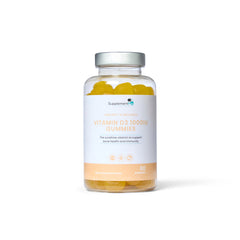
Vitamin D3 1000iu Gummies
Our Vitamin D gummies use vitamin D3. The current label provides 25 micrograms (1,000 IU) of vitamin D3 per one-gummy daily serving. Always use the product page and physical label for the current serving directions and full ingredient information.
Evidence note
This guide is educational and is not a substitute for personalised medical advice. The references below explain the scientific and public-health concepts discussed in the article. They are not evidence that a particular SupplementMe product will produce a specific health outcome. If you are pregnant, breastfeeding, taking medicines, managing a medical condition or unsure whether a supplement is suitable for you, speak to a qualified healthcare professional.
Sources & Further Reading
We prioritise peer-reviewed research, systematic reviews and authoritative UK guidance. Sources were checked when this article was prepared on 24 August 2026.
Balachandar R, Pullakhandam R, Kulkarni B, Sachdev HS. Relative Efficacy of Vitamin D2 and Vitamin D3 in Improving Vitamin D Status: Systematic Review and Meta-Analysis. Nutrients. 2021;13(10):3328. [Peer-reviewed systematic review and meta-analysis] DOI: 10.3390/nu13103328
View source →van den Heuvel EGHM, Lips P, Schoonmade LJ, Lanham-New SA, van Schoor NM. Comparison of the Effect of Daily Vitamin D2 and Vitamin D3 Supplementation on Serum 25-Hydroxyvitamin D Concentration and Importance of Body Mass Index: A Systematic Review and Meta-Analysis. Advances in Nutrition. 2024;15(1):100133. [Peer-reviewed systematic review and meta-analysis] DOI: 10.1016/j.advnut.2023.09.016
View source →Scientific Advisory Committee on Nutrition. Fortifying foods and drinks with vitamin D: main report. 2024. Includes UK discussion of dietary and supplement sources of vitamin D2 and D3. [UK scientific advisory report]
View source →Cardwell G, Bornman JF, James AP, Black LJ. A Review of Mushrooms as a Potential Source of Dietary Vitamin D. Nutrients. 2018;10(10):1498. [Peer-reviewed scientific review] DOI: 10.3390/nu10101498
View source →NHS. Vitamin D: vitamins and minerals guidance. Includes the vitamin D conversion 1 microgram = 40 IU and current UK supplementation advice. [Official UK health guidance]
View source →Keep reading

When Is a Supplement Really Vegan? Capsules, Vitamin D and Ingredient Labels Explained
Capsule shells, vitamin D sources and vegan labels explained, plus a practical checklist for reading the full supplement...

Multivitamin or Individual Supplements: What's the Difference?
Multivitamins and individual supplements compared in plain English, with a practical checklist for avoiding duplicated nutrients.

What Is Acerola? Vitamin C from Fruit Explained
Acerola fruit, extracts and vitamin C amounts explained, including the label details that matter when comparing supplements.