
Prebiotics vs Probiotics: What's the Difference?
Prebiotics and probiotics explained in plain English, including the scientific definitions, common misconceptions and what to look for on a label.

QUICK ANSWER
Probiotics are live microorganisms that, when administered in adequate amounts, confer a health benefit on the host. Prebiotics are substrates that are selectively used by host microorganisms and confer a health benefit. In simple terms, the probiotic is the microorganism; the prebiotic is a substance selected microorganisms can use.[1][2]
Prebiotic and probiotic sound close enough that they are often used as if one is just a spelling variation of the other. They are not. One refers to live microorganisms. The other refers to substances that selected microorganisms can use.
That basic distinction is easy. The interesting part is that both words have scientific definitions, so phrases such as 'good bacteria food' and 'live cultures' are useful shortcuts but do not tell the whole story.
What is a probiotic?
The widely accepted scientific definition describes probiotics as live microorganisms that, when administered in adequate amounts, confer a health benefit on the host.[1]
That definition has several parts. The microorganisms need to be alive, they need to be given in an adequate amount and there needs to be evidence of a health benefit. A product simply containing some live microorganisms does not automatically make every broad health claim about it a probiotic claim supported by evidence.
What is a prebiotic?
A prebiotic is not a microorganism. The current expert consensus definition is a substrate that is selectively utilised by host microorganisms and confers a health benefit.[2]
Common examples discussed in prebiotic research include inulin-type fructans, fructooligosaccharides, galactooligosaccharides and some resistant starches. What matters is not just that the substance is a carbohydrate or fibre. To meet the scientific definition, selective microbial use and a health benefit need to be demonstrated.[2][6]
THE THREE TERMS IN ONE LINE
Probiotic = live microorganism. Prebiotic = substrate selectively used by host microorganisms. Synbiotic = a mixture containing live microorganisms and substrate or substrates selectively used by host microorganisms that confers a health benefit.[1][2][3]
Are prebiotics just food for "good bacteria"?
That is a handy way to picture the idea, but it is a little too broad. The scientific definition does not say that a prebiotic simply feeds all 'good bacteria'. It requires selective utilisation by host microorganisms and evidence of a health benefit.[2]
The microbiome is also more complicated than dividing every organism into a permanent good or bad category. Effects can depend on the ingredient, the amount, the microorganisms already present and the outcome being measured.
Is all fibre prebiotic?
No. Many recognised prebiotics are dietary fibres, but the words are not interchangeable. A fibre can be useful nutritionally without meeting the scientific definition of a prebiotic. The modern definition can also include certain non-carbohydrate substances if they meet the same selective-utilisation and health-benefit criteria.[2]
Is yoghurt automatically a probiotic food?
Not automatically. Fermented foods can contain live microorganisms, but fermentation and probiotic are not synonymous. An expert consensus on fermented foods makes a clear distinction: a fermented food only qualifies as probiotic in the scientific sense when the relevant live microorganisms and health benefit are appropriately demonstrated.[1][5]
What is a synbiotic?
A synbiotic combines live microorganisms with a substrate or substrates selectively utilised by host microorganisms, with evidence that the combination confers a health benefit. The 2020 ISAPP consensus deliberately updated this definition to be more precise.[3]
So adding a random fibre to a probiotic capsule does not automatically prove a synbiotic benefit. The finished combination still needs to meet the definition.
| Term | What it refers to | Simple example |
|---|---|---|
| Probiotic | Live microorganism given in an adequate amount with evidence of a health benefit. | A defined live bacterial or yeast strain used at an evidence-based amount. |
| Prebiotic | A substrate selectively utilised by host microorganisms that confers a health benefit. | A defined prebiotic fibre such as an inulin-type fructan when the evidence supports the use. |
| Synbiotic | A mixture of live microorganisms and selectively utilised substrate(s) that confers a health benefit. | A defined probiotic plus substrate combination supported as a synbiotic. |
Which is better, a prebiotic or a probiotic?
There is no useful universal winner because they are different interventions. A probiotic introduces live microorganisms. A prebiotic provides a substrate that selected microorganisms can use. Which one has relevant evidence depends on the exact strain or ingredient, the amount, the population and the outcome being studied.
That is why broad 'gut health' claims deserve a closer look. A systematic review and meta-analysis of prebiotics in adults with irritable bowel syndrome and other functional bowel disorders found that overall gastrointestinal symptoms and quality of life did not improve compared with placebo, although bifidobacteria increased and some results varied by prebiotic type and dose.[4] The lesson is not that prebiotics are useless. It is that the specific ingredient, dose and outcome matter.
What should you look for on a label?
For a probiotic, look for the microorganisms included, strain information where available, the CFU amount, the serving and the storage or shelf-life information. For a prebiotic, look for the specific ingredient and the amount supplied rather than relying only on the word 'fibre'.
If a product calls itself a synbiotic, look for clear information about both the live microorganisms and the substrate. The label should help you understand what is actually in the combination rather than asking the word 'synbiotic' to do all the work.
The practical takeaway
Probiotics and prebiotics can both interact with the microbiome, but they do it in different ways. One is the live microorganism; the other is the substrate. Once you know that distinction, product labels become much easier to read and research becomes much harder to accidentally overgeneralise.
WHAT TO REMEMBER
- Probiotics are live microorganisms with evidence of benefit at an adequate amount.
- Prebiotics are substrates selectively utilised by host microorganisms with evidence of a health benefit.
- Not every fibre is automatically a prebiotic.
- Fermented food and probiotic are not interchangeable terms.
- A synbiotic is more specific than simply putting a probiotic and a fibre in the same product.
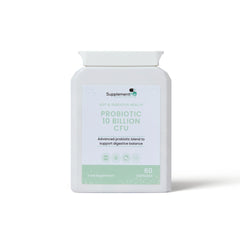
From our range
Probiotic 10 Billion CFU
Our Probiotic Complex is a probiotic supplement. This guide does not imply that it is a prebiotic or synbiotic product. Use the current product page and physical label for the full microorganism list, ingredients, serving directions and storage information.
Evidence note
This guide is educational and is not a substitute for personalised medical advice. The references below explain the scientific and public-health concepts discussed in the article. They are not evidence that a particular SupplementMe product will produce a specific health outcome. If you are pregnant, breastfeeding, taking medicines, managing a medical condition or unsure whether a supplement is suitable for you, speak to a qualified healthcare professional.
Sources & Further Reading
We prioritise peer-reviewed research, systematic reviews and authoritative UK guidance. Sources were checked when this article was prepared on 24 August 2026.
Hill C, Guarner F, Reid G, et al. The International Scientific Association for Probiotics and Prebiotics consensus statement on the scope and appropriate use of the term probiotic. Nature Reviews Gastroenterology & Hepatology. 2014;11(8):506-514. [Peer-reviewed expert consensus] DOI: 10.1038/nrgastro.2014.66
View source →Gibson GR, Hutkins R, Sanders ME, et al. The International Scientific Association for Probiotics and Prebiotics consensus statement on the definition and scope of prebiotics. Nature Reviews Gastroenterology & Hepatology. 2017;14(8):491-502. [Peer-reviewed expert consensus] DOI: 10.1038/nrgastro.2017.75
View source →Swanson KS, Gibson GR, Hutkins R, et al. The International Scientific Association for Probiotics and Prebiotics consensus statement on the definition and scope of synbiotics. Nature Reviews Gastroenterology & Hepatology. 2020;17:687-701. [Peer-reviewed expert consensus] DOI: 10.1038/s41575-020-0344-2
View source →Wilson B, Rossi M, Dimidi E, Whelan K. Prebiotics in irritable bowel syndrome and other functional bowel disorders in adults: a systematic review and meta-analysis of randomized controlled trials. American Journal of Clinical Nutrition. 2019;109(4):1098-1111. [Peer-reviewed systematic review and meta-analysis] DOI: 10.1093/ajcn/nqy376
View source →Marco ML, Sanders ME, Ganzle M, et al. The International Scientific Association for Probiotics and Prebiotics consensus statement on fermented foods. Nature Reviews Gastroenterology & Hepatology. 2021;18:196-208. [Peer-reviewed expert consensus] DOI: 10.1038/s41575-020-00390-5
View source →Sanders ME, Merenstein DJ, Reid G, Gibson GR, Rastall RA. Probiotics and prebiotics in intestinal health and disease: from biology to the clinic. Nature Reviews Gastroenterology & Hepatology. 2019;16(10):605-616. [Peer-reviewed scientific review] DOI: 10.1038/s41575-019-0173-3
View source →Keep reading

When Is a Supplement Really Vegan? Capsules, Vitamin D and Ingredient Labels Explained
Capsule shells, vitamin D sources and vegan labels explained, plus a practical checklist for reading the full supplement...

Multivitamin or Individual Supplements: What's the Difference?
Multivitamins and individual supplements compared in plain English, with a practical checklist for avoiding duplicated nutrients.

What Is Acerola? Vitamin C from Fruit Explained
Acerola fruit, extracts and vitamin C amounts explained, including the label details that matter when comparing supplements.