
How to Read a Supplement Label: A Simple Guide
Serving size, NRV, ingredients and warnings explained in plain English, plus a quick checklist you can use on almost any supplement label.

Quick answer
Start with the recommended daily serving, not the biggest number on the front. Then check the amount of each active ingredient, any NRV percentages, the full ingredients list, allergens, warnings, storage instructions and best-before date. In the UK, food supplement labels must include several of these details by law.[1][2]
Pick up almost any supplement and the front is easy: product name, a few ingredients and a number that looks important. Turn the bottle around and things get busier. You might see milligrams, micrograms, percentages, a long ingredients list and several warnings packed into a small space.
That extra detail is not there to make life difficult. It is the part that lets you compare products properly. Research on food labelling has repeatedly found that people do use labels, but numerical information and technical wording are not always understood consistently.[4][5] A simple order of operations makes the whole thing much easier.
1. Start with the recommended daily serving
Before looking at any nutrient amount, find the serving or recommended daily dose. This tells you how many tablets, capsules or gummies the numbers on the label actually refer to.
A bottle can contain 60 gummies and still provide only 30 daily servings if the directions say to take two gummies per day. Likewise, a label may advertise 1,200 mg on the front while the ingredient panel makes clear that 1,200 mg is supplied by a two-unit daily serving, not by each individual gummy.
For food supplements sold in England, the label must state the portion recommended for daily consumption and include a warning not to exceed the stated recommended daily dose.[2] So this is one of the most useful places to begin.
A quick habit
When comparing two supplements, convert both to the amount per recommended daily serving first. Comparing ‘per capsule’ on one product with ‘per two gummies’ on another can make two similar products look very different.
2. Check the amount of each active ingredient
Next, look at how much of each vitamin, mineral, botanical or other active ingredient is provided by that daily serving. The units matter.
- mg means milligrams.
- mcg or µg means micrograms. One milligram is 1,000 micrograms.
- IU means International Units. IU conversions are nutrient-specific, so you cannot use one universal conversion for every vitamin.
A large-looking number is not automatically a better dose. Different nutrients are measured on very different scales, and some ingredients use standardised extracts or other forms that need more context than a single number can provide.
3. What does %NRV mean?
NRV stands for Nutrient Reference Value. On UK and European-style labels, it provides a standard reference point for the amounts of vitamins and minerals in a food or supplement.[3]
If a vitamin is listed as 100% NRV, the amount in the stated serving equals the reference value used for nutrition labelling. If it says 200% NRV, the serving provides twice that labelling reference value.
The important bit is what NRV does not mean. It is not a personalised prescription, it does not tell you that everyone needs exactly that amount, and a higher percentage does not automatically make one product better than another. Individual requirements can vary with age, diet, health, pregnancy and other factors.
You will also see ingredients with no NRV at all. That is normal. Many botanical ingredients and other substances do not have an established NRV under the nutrition-labelling framework.
4. Read the full ingredients list, not just the front
The front of the bottle highlights the ingredients the brand wants you to notice. The ingredients list shows the full formulation.
Under food information rules, ingredients are generally listed in descending order by weight as used in manufacture, and regulated allergens must be identified clearly.[1][3] For a supplement, that list can also tell you about capsule shells, glazing agents, flavourings, sweeteners, colours, anti-caking agents and other ingredients that may matter to you.
If you follow a vegan or vegetarian diet, do not rely only on how a product looks. Check the ingredient list and the product's dietary statement. Capsule shells can be made from different materials, and gummies can use either animal-derived gelatin or plant-based gelling agents such as pectin.
5. Do not skip warnings, storage and the date
Food supplement labels in the UK have specific labelling requirements. These include directions for use, a warning not to exceed the recommended daily dose, a statement that supplements should not replace a varied diet, storage information and a best-before or use-by date where applicable.[1][2]
Those lines matter. Some products have extra warnings because of their ingredients or the group they are intended for. Storage instructions matter too, especially for products that can be affected by heat, moisture or light.
If a product says to store it in a cool, dry place, keeping it next to a steamy shower or above a hot cooker is probably not the best idea.
6. Treat front-of-pack claims as the start, not the answer
Front labels have limited space, so they simplify. That is fine as long as you use them as a starting point rather than the whole comparison.
Words such as ‘high strength’, ‘complex’, ‘premium’ or ‘advanced’ are not universal scientific measures. Two products using the same marketing phrase can contain very different ingredients and daily doses. The useful comparison is still the underlying label: ingredient, form, amount, daily serving and any relevant standardisation.
A 60-second supplement label check
- How many tablets, capsules or gummies make up the daily serving?
- How much of each active ingredient does that serving provide?
- For vitamins and minerals, what %NRV is shown?
- What is in the full ingredients list, including allergens and capsule or gummy ingredients?
- Are there any warnings that apply to you?
- How should it be stored?
- What is the best-before date?
- Does the front-of-pack wording match what the detailed label actually says?
Once you get used to checking those eight things, supplement labels stop feeling like a wall of tiny text. You also become much better at comparing two products on what is actually in them rather than on packaging alone.
What to remember
- Compare products using the amount per recommended daily serving.
- NRV is a standard labelling reference value, not a personalised target.
- The full ingredients list can tell you things the front of the bottle cannot.
- Warnings, storage instructions and best-before dates are part of the useful information, not filler.
- A large number or strong-sounding marketing phrase should never replace reading the actual label.
From our range
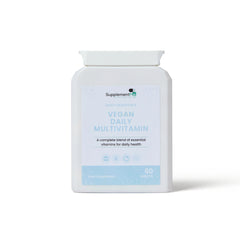
Vegan Daily Multivitamin
A multivitamin is a useful example for practising label reading, because several nutrients, amounts and NRV percentages sit together in one panel. Use the product page and the physical label for the current formulation and daily serving instructions.
Evidence note
This guide is educational and is not a substitute for personalised medical advice. The references below explain the scientific and regulatory concepts discussed in the article. They are not evidence that a particular SupplementMe product will produce a specific health outcome. If you are pregnant, breastfeeding, taking medicines, managing a medical condition or unsure whether a supplement is suitable for you, speak to a qualified healthcare professional.
Sources & Further Reading
We prioritise peer-reviewed research, systematic reviews and authoritative UK guidance. Sources were checked when this article was prepared on 16 August 2026.
UK Government / Food Standards Agency. Food supplements: labelling and composition guidance. Updated guidance accessed 16 August 2026.
Official UK guidance →The Food Supplements (England) Regulations 2003, Regulation 6: restrictions on sale relating to labelling of food supplements.
UK legislation →Regulation (EU) No 1169/2011 on the provision of food information to consumers, including ingredient-list and nutrient reference information retained in UK law as applicable.
Food information law →Campos S, Doxey J, Hammond D. Nutrition labels on pre-packaged foods: a systematic review. Public Health Nutrition. 2011;14(8):1496-1506. DOI: 10.1017/S1368980010003290
Peer-reviewed systematic review →Cowburn G, Stockley L. Consumer understanding and use of nutrition labelling: a systematic review. Public Health Nutrition. 2005;8(1):21-28. DOI: 10.1079/PHN2005666
Peer-reviewed systematic review →Keep reading

When Is a Supplement Really Vegan? Capsules, Vitamin D and Ingredient Labels Explained
Capsule shells, vitamin D sources and vegan labels explained, plus a practical checklist for reading the full supplement...

Multivitamin or Individual Supplements: What's the Difference?
Multivitamins and individual supplements compared in plain English, with a practical checklist for avoiding duplicated nutrients.

What Is Acerola? Vitamin C from Fruit Explained
Acerola fruit, extracts and vitamin C amounts explained, including the label details that matter when comparing supplements.