
Do Supplements Expire? Best-Before Dates, Storage and What Changes Over Time
Best-before dates, storage and changes over time explained for capsules, tablets, gummies and probiotic supplements.

QUICK ANSWER
Supplements can change over time. A best-before date is mainly about expected quality, not the same safety cut-off as a use-by date, but it only makes sense when the product has been stored as instructed.[1][2] Heat, moisture, light, oxygen, packaging and the type of ingredient can all affect stability. Probiotics need particular attention because the number of viable microorganisms can fall during storage and after the expiry date.[3][4] If the packaging is damaged, storage has been poor or you are unsure about an old product, follow the label and ask the manufacturer or a pharmacist.
A supplement does not necessarily become useless at midnight on one date. It also does not stay unchanged forever. The date and storage instructions describe the conditions under which the manufacturer expects the product to remain within its intended quality specification.
That is why the most useful answer is product-specific. A dry tablet, a gummy and a live-culture probiotic do not have the same formulation or stability questions.
Best before and use by are different
The Food Standards Agency explains that a best-before date is about quality, while a use-by date is about safety.[2] Food supplement guidance requires the relevant date and storage information to appear on the label.[1]
Many shelf-stable supplements use best-before wording. That does not guarantee that an old product has retained its declared potency, texture or viable count. It means the date should be read as a quality marker together with the stated storage conditions.
What can change over time?
An ingredient can degrade chemically, a tablet can absorb moisture, a gummy can change texture, a capsule shell can become brittle or soft, and a probiotic can lose viable microorganisms. Some changes are visible, while loss of nutrient content or probiotic viability may not be.
Research on vitamin stability identifies light, oxygen and heat as important degradation factors, although the rate depends on the vitamin and the formulation.[5] That is why one universal expiry rule would be misleading.
APPEARANCE IS NOT A POTENCY TEST
A product that looks normal is not proof that every nutrient or live culture remains at the declared amount. Equally, a texture change does not tell you exactly which ingredient changed. Use the date, storage history and packaging condition rather than relying on appearance alone.
Heat, moisture, light and air
| Factor | Possible effect | Practical label-led response |
|---|---|---|
| Heat | Can speed some degradation reactions and affect textures. | Keep within the temperature conditions stated on the label. |
| Moisture | Can affect tablets, powders, gummies, capsules and probiotic stability. | Keep the container closed and use a dry storage place when instructed. |
| Light | Can contribute to degradation of light-sensitive ingredients. | Keep the product out of direct sunlight when the label says so. |
| Oxygen | Can contribute to oxidation after air enters the pack. | Close the packaging properly after use. |
| Damaged packaging | May compromise the protection designed into the pack. | Do not rely on a damaged seal or container; contact the seller or manufacturer. |
Why the original packaging matters
A bottle, blister or pouch is part of the product's stability system. It may control exposure to moisture, light, oxygen or handling. Moving supplements into an unlabelled container also separates them from the batch number, date, directions and warnings.
Unless a healthcare professional has advised a suitable organiser, keeping the product in its labelled packaging makes it easier to preserve and identify correctly.
What about capsules, tablets and gummies?
Dry formats are often designed for room-temperature storage, but that does not mean every cupboard is suitable. Bathrooms can be humid and kitchens can experience heat and steam. Follow the actual label, which may say to keep the product cool, dry, dark or out of direct sunlight.
Gummies can be especially noticeable when their texture changes, but visible texture is only one quality measure. Do not use softness, stickiness or colour alone to judge nutrient content.
Why probiotics deserve extra attention
Probiotic products contain live microorganisms, so viable count is a central quality measure. A study of expired probiotic products found that some still contained viable organisms, but most viable counts were below the amount originally intended by the manufacturer. Packaging, storage and time since expiry all mattered.[3]
A review of probiotic stability also highlights formulation, drying, moisture and storage conditions as important to survival.[4] The practical message is simple: use the product within its stated date and storage conditions rather than assuming all probiotics behave the same.
What should you do with an old supplement?
- Check whether the pack says best before or use by.
- Read the exact storage instructions and consider whether they were followed.
- Check the seal, container and batch information.
- Do not rely on smell or appearance to confirm nutrient potency or probiotic viability.
- If the product is outside its date, damaged or of uncertain storage history, ask the manufacturer or a pharmacist rather than guessing.
WHAT TO REMEMBER
- Best before is mainly about quality; use by is a safety date.
- The date assumes the product has been stored as instructed.
- Heat, moisture, light, oxygen and packaging can all affect stability.
- Different formats and ingredients change in different ways.
- Probiotic viable counts can fall over time, so their date and storage instructions deserve particular attention.
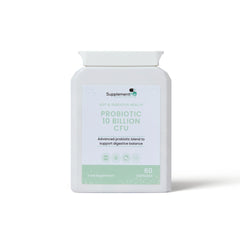
From our range
Probiotic 10 Billion CFU
Our current probiotic label states that the product should be stored in a cool, dry and dark place under 25 degrees, out of reach of children. Follow the current label and best-before information, and keep the container closed as directed.
Evidence note
This guide is educational and is not a substitute for personalised medical advice. The references below explain the scientific, regulatory and public-health concepts discussed in the article. They are not evidence that a particular SupplementMe product will produce a specific health outcome. If you are pregnant, breastfeeding, taking medicines, managing a medical condition or unsure whether a supplement is suitable for you, speak to a qualified healthcare professional.
Sources & Further Reading
We prioritise peer-reviewed research, systematic reviews and authoritative UK guidance. Sources were checked when this article was prepared on 19 September 2026.
UK Government. Food supplements: guidance on labelling and composition requirements, including storage instructions and date marking. [Official UK guidance]
View source →Food Standards Agency. Chapter 4: Informing consumers, latest developments in food labelling and information. Explains the difference between best-before and use-by dates. [Official UK food guidance]
View source →Wilcox H, Carr C, Seney S, Reid G, Burton JP. Expired probiotics: what is really in your cabinet? FEMS Microbes. 2020;1(1):xtaa007. [Peer-reviewed laboratory study] DOI: 10.1093/femsmc/xtaa007
View source →Dianawati D, Mishra V, Shah NP. Survival of Microencapsulated Probiotic Bacteria after Processing and during Storage: A Review. Critical Reviews in Food Science and Nutrition. 2016;56(10):1685-1716. [Peer-reviewed scientific review] DOI: 10.1080/10408398.2013.798779
View source →Schnellbaecher A, Binder D, Bellmaine S, Zimmer A. Vitamins in cell culture media: Stability and stabilization strategies. Biotechnology and Bioengineering. 2019;116(6):1537-1555. Discusses the effects of light, oxygen and heat on vitamin stability and the relevance of these concepts to food supplements. [Peer-reviewed scientific review] DOI: 10.1002/bit.26942
View source →Keep reading

When Is a Supplement Really Vegan? Capsules, Vitamin D and Ingredient Labels Explained
Capsule shells, vitamin D sources and vegan labels explained, plus a practical checklist for reading the full supplement...

Multivitamin or Individual Supplements: What's the Difference?
Multivitamins and individual supplements compared in plain English, with a practical checklist for avoiding duplicated nutrients.

What Is Acerola? Vitamin C from Fruit Explained
Acerola fruit, extracts and vitamin C amounts explained, including the label details that matter when comparing supplements.